Community · 6 min read
Teaching Kids to Be Generous: 12 Simple Ways to Start Today
Teaching kids to be generous starts at home. Try 12 simple, age-friendly ways to build giving habits, from allowance splits to family giving days.
Illustrative image
Children are not born knowing how to give. They are born knowing how to want. The good news is that generosity is a habit, and habits can be taught, especially by watching people they love.
You do not need a big budget or a perfect speech. You need a few small, steady practices that make giving feel normal and joyful.
Key takeaways
- Children learn generosity by doing it, not only hearing about it.
- Let kids choose how and where to give, so the habit belongs to them.
- Keep lessons honest, age-appropriate, and hopeful.
- Pair every conversation about need with a small action.
- Small gifts count, and family traditions last.
Why start young
Children notice more than we think. They see who gets a seat at the table and who does not. They hear when adults talk about people who struggle. They also learn from what we do with our money, our time, and our attention.
When a child learns early that they can help, they gain something valuable: a sense of agency. A child who knows they can make someone's day better is less likely to feel helpless about hard things. That is a gift to the child as well as to the people they help.
12 simple ways to start
1. Use three jars
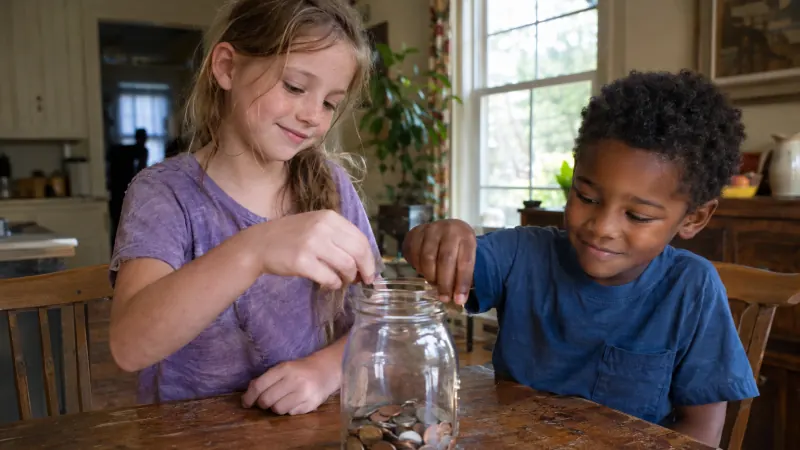
Give each child three jars labeled spend, save, and give. When allowance or gift money arrives, they split it. Let the child decide the split, even if the give jar is small.
2. Let them choose the cause
Ask, "Who would you like to help with this money?" Show a few options, such as children who need food, school supplies, or a safe place to live. When the choice is theirs, the giving feels real.
3. Make giving a family tradition
Pick a regular day, such as the first of the month, when your family gives together. A monthly rhythm builds a habit. It also matches how need works, since a child's needs come every month.
4. Talk about need in simple words
Say, "Some families do not have enough food, and we can help." Keep it honest and gentle. Skip graphic details, and focus on what people can do.
5. Shop for others
At the grocery store, let a child pick items for a food drive. They learn that real children eat the food they choose. Counting the items at home makes it concrete.
6. Swap a gift for a gift
Before a birthday, invite your child to ask friends for a donation instead of presents, or to split the difference. Our guide to starting a birthday fundraiser shows how.
7. Give a little of their own work
Chores, a lemonade stand, or a bake sale can raise a small amount. When kids give money they earned, they feel the effort and the reward.
8. Volunteer together
Time counts too. Serve at a food drive, a clean-up, or a school event. The federal agency AmeriCorps lists ways to find volunteer opportunities. We discuss how time and money fit together in volunteering versus donating.
9. Read stories about kindness
Books and stories spark conversation. Ask what the characters did, how others felt, and what your child might do.
10. Model it out loud
Let your children see you give. Say, "I am setting up a monthly gift because children need help." Kids copy what they see.
11. Say thank you and notice thanks
Gratitude and generosity grow together. At dinner, ask, "What are you thankful for today? Who helped us?" Children who feel grateful are often more willing to share.
12. Celebrate small gifts
A child's $5 matters as much as an adult's $500 in the way it shapes their heart. Praise the act, not the amount.
What to say about poverty and hunger
Parents often worry that talking about hunger or poverty will frighten children. A calm, honest tone helps. You might say:
- "Some kids do not have enough to eat, and that is not their fault."
- "Neighbors and charities work together to help."
- "We can do something small today."
The USDA's Economic Research Service reports each year on households that struggle to get enough food. According to the USDA, millions of children live in such households. Feeding America explains child hunger for general readers. You can use these sources to answer your own questions before you talk with your children.
The goal is not to make a child sad. The goal is to help them see people, and to see that they can help.
Choose a charity together
Let your child be part of picking where the money goes. You can show them the programs of Plondo Foundation, a 501(c)(3) public charity in Monroe, Louisiana, whose mission is that every child in northeast Louisiana and beyond has shelter, food, water, and the education and support to thrive. Its four programs are Scholarship Programs, Living Expense Support, Essential Resources, and Sports & Community.
Ask your child which one speaks to them. A child who loves soccer may choose Sports & Community. A child who loves school may choose Scholarship Programs. All are good answers.
How to handle the practical parts
If your child is giving online, you will likely handle the payment. Explain what you are doing. Show the receipt when it arrives by email. Talk about how you checked the charity first, and point them to our guide on how to check if a charity is legitimate.
A small gift is enough. A gift of $25 can help provide food and clean water for a child, and many families like to make that a shared monthly gift. Read more about the power of that amount in what $25 can do for a child.
Common stumbling blocks
"My child thinks it is unfair to give up their money." That is normal. Keep the give share small at first and let the child pick the cause.
"We do not have much to give." Giving does not require wealth. Small gifts and time both count. Generosity is a habit of attention.
"My child forgets." Use a visible reminder, such as a jar on the shelf or a calendar mark.
"My teen thinks it is pointless." Share real stories and let them take the lead on a project, like a fundraiser for a cause they care about.
A simple family giving night
Pick one evening a month. Eat dinner, then put out your three jars. Let each child say one thing they noticed this month that made them grateful. Then ask who they want to help. Write the answer on a sticky note and decide on an amount together.
Keep it short, about fifteen minutes. A ritual that is quick and warm is a ritual that lasts. Over a year, your children will have twelve small lessons in noticing and acting.
Raise a giver
The habits your children form now will follow them. A child who learns to give at eight may still give at eighty. Generous kids grow into generous neighbors, and generous neighbors build better communities.
Start this week. Fill a jar. Pick a cause. Give a gift together. You can make your family's first gift at /donate, one time or monthly. A receipt arrives by email, and your child will see where kindness goes.
If you have questions, see the FAQ or write to foundation@plondo.com. Then show your child what it feels like to help another child. It is one of the best lessons you can teach.
Frequently asked questions
At what age can children start learning about giving?
Very young children can begin. Toddlers can share toys and help pick out food for a drive. School-age children can understand that some families go without and can help choose a charity. Teens can plan a fundraiser. Match the activity to your child's age and keep it positive.
How much should kids give from their allowance?
There is no single right number. Many families use a simple split, such as spending, saving, and giving jars. Let the child choose the giving amount, even if it is small. Choice builds ownership, and the habit matters more than the amount.
How do I explain poverty to a child without scaring them?
Use simple, honest words and focus on what people can do. You might say some families do not have enough food, and neighbors can help. Avoid graphic details. Pair the lesson with an action, such as a gift or a food drive, so the child feels useful and hopeful.